
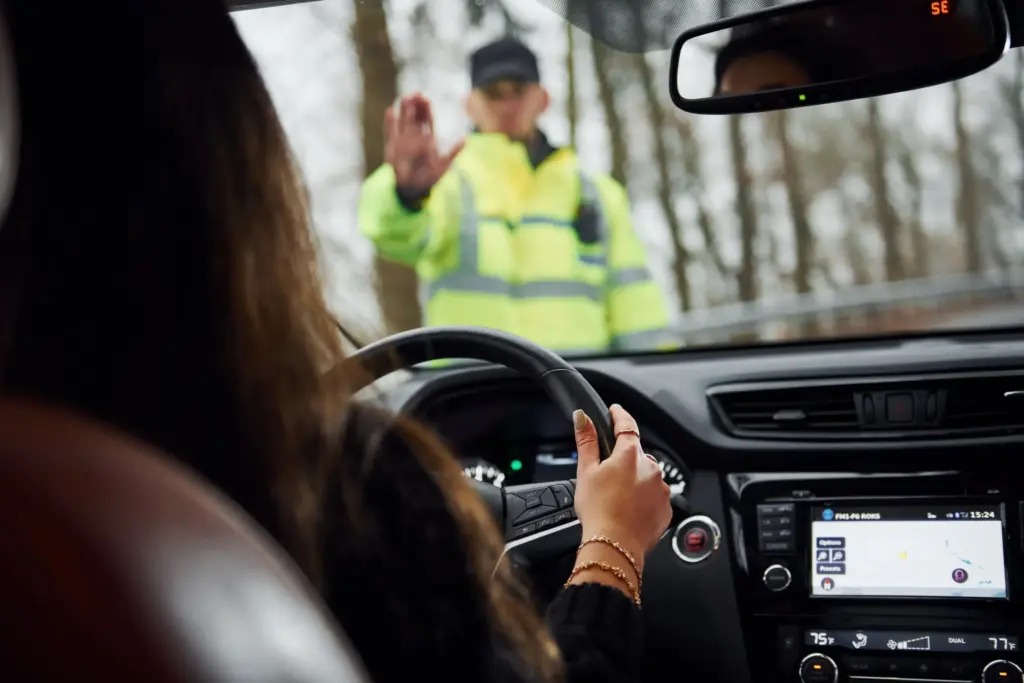
Your DUI checkpoint rights in Las Vegas are simpler than the internet makes them: checkpoints are legal, they have strict rules of their own to follow, you must stop and hand over your license — and almost everything else is your choice. Knowing which is which, before the flashing lights are in your mirror, is the difference between a two-minute wave-through and a case. Here’s the whole picture, from a defense team that litigates what happens when checkpoints go wrong.
Are DUI Checkpoints Legal in Las Vegas?
Yes. The U.S. Supreme Court held in Michigan Department of State Police v. Sitz, 496 U.S. 444 (1990), that sobriety checkpoints don’t violate the Fourth Amendment, and Nevada expressly authorizes them by statute as ‘administrative roadblocks’ under NRS 484B.570. Las Vegas Metropolitan Police run them regularly — holiday weekends, event nights, known corridors. So the useful question isn’t whether checkpoints are legal in general. It’s whether the one that stopped YOU was legal in particular — because the statute attaches real requirements, and checkpoints that skip them are challengeable.


The Rules Every Checkpoint Has to Follow
NRS 484B.570 isn’t a suggestion — it’s a specification sheet. A Nevada roadblock must have, at minimum:
| Requirement | Statutory spec |
|---|---|
| Visibility of the roadblock itself | Clearly visible to approaching traffic from at least 100 yards in both directions |
| Stop signal | A ‘stop’ sign near the centerline, readable from at least 50 yards — day or night |
| Warning light | At least one red flashing or intermittent light, lit, visible from at least 100 yards |
| Advance warning signs | ‘Police stop’ warning signs with a burning light, flare, or lantern — at least ¼ mile before the roadblock on open highway, at least 700 feet in cities and towns |
Why the numbers matter: when a checkpoint fails its own specifications, the stop’s legality comes into question — and with it, everything the stop produced. When we take a checkpoint case, the first homework is measuring the State’s setup against this table, with photographs, officer testimony, and the operation plan the agency wrote before the night began. Agencies also announce many checkpoints in advance and follow internal protocols on where and how they run — paperwork that exists before the first car is stopped, and that the defense is entitled to examine afterward. A checkpoint isn’t just cones on asphalt; it’s a documented operation, and documents can be held to their own standards.
Your Rights at the Stop, Lane by Lane
What you must do: stop, and produce your driver’s license on demand — Nevada law requires carrying it and showing it to a peace officer when asked. As a practical matter, have registration and proof of insurance reachable too, so the encounter stays short.
What you may decline: conversation. ‘Where are you coming from?’ and ‘Have you been drinking tonight?’ are questions, not orders, and the Fifth Amendment lets you answer with a polite ‘I’d rather not discuss my evening, officer.’ Expect that to draw a longer look — declining questions isn’t a free pass out of scrutiny — but your words are the cheapest evidence the State ever collects, and you’re allowed to keep them.
Field sobriety tests — the walk-and-turn, one-leg stand, eye-tracking — are voluntary in Nevada. No implied-consent statute covers them, and they’re graded on judgment calls you can’t audit at the roadside. The roadside breath screen (PBT) is different: refuse it and, if the officer otherwise has grounds, the statute directs an arrest — and after arrest, the evidentiary test carries license consequences of its own. The full decision tree lives in our companion guide to refusing a breathalyzer in Nevada; the short version is that tests have different rules, and knowing which is which matters more than any single answer.
Can You Turn Around Before a Checkpoint?
The honest answer: no Nevada statute and no published Nevada decision makes it illegal to lawfully avoid a checkpoint — a legal U-turn or a turn onto a side street before you reach the traffic control is not, by itself, a crime. The trap is in the word ‘lawfully.’ An illegal U-turn, a missed signal, a wide turn, or crossing a solid line hands the officer a traffic violation, and the traffic violation is its own reason to stop you — checkpoint avoided, stop earned anyway. If you turn around, do it the way you’d drive with an examiner in the passenger seat. And know that officers watch the approach for exactly this — a clean, legal turn is unremarkable; a panicked one is an invitation.
What Happens If You Drive Through a Checkpoint?
Improper stops are challenged as unlawful police stops. Blowing past the cones is where the penalties live. Under NRS 484B.580, proceeding through a roadblock without submitting to the traffic control — or disobeying officers’ lawful orders there — is a gross misdemeanor, punishable by up to 364 days in jail. If driving through directly causes death, substantial bodily harm, or property damage over $1,000, it becomes a category B felony carrying 1 to 6 years in prison and a fine of up to $5,000. There is no version of the night where accelerating through a checkpoint improves it. Stop, be brief, be polite, and save the arguments for a courtroom, where they actually work.
The Mistakes We See Most at Checkpoints
From years of defending these cases: cracking the window an inch and escalating a routine stop into a standoff. Arguing law at the cone line — officers don’t dismiss cases, judges do. Refusing to hand over a license, which converts a rights question into an offense. Volunteering a timeline of the evening unprompted, complete with the name of the second bar. And performing field sobriety tests on a bad knee, in heels, at 1 a.m., without knowing they were optional. None of these people were criminals; all of them made their eventual case harder in under three minutes. The pattern underneath every mistake is the same: treating the checkpoint as a conversation to win instead of a procedure to pass. If any of this already happened, that’s what the consultation is for — our Las Vegas DUI lawyer team has un-tangled worse, and the earlier we start, the more options survive. What follows an arrest — license clocks, hearings, penalties — is mapped on our Nevada DUI penalties page.


Improper procedure is common, and our DUI defense team reviews how each stop was run.
DUI Checkpoints in Las Vegas
Frequently Asked Questions
Do I have to answer the officer’s questions?
No. You must stop and show your license; you don’t have to narrate your evening. A polite decline is lawful — expect extra attention, not a charge. What you say at the window is evidence; what you don’t say isn’t.
Can I refuse the field sobriety tests?
Yes — FSTs are voluntary in Nevada. Refusing them isn’t a crime and carries no automatic license penalty. Keep that separate from the roadside breath screen and the post-arrest evidentiary test, which follow different statutes with real consequences — the distinction is exactly where drivers get tripped.
Is it illegal to turn around before a DUI checkpoint?
Not if the maneuver itself is legal. No Nevada statute punishes lawful avoidance — but any traffic violation in the turn gives police an independent reason to stop you. Signal, turn legally, or just go through; a compliant two-minute stop beats a lawful-but-sloppy escape.
What if the checkpoint had no signs or lights?
That matters — a lot. NRS 484B.570 sets minimum visibility, signage, and lighting requirements, and a checkpoint that failed them is open to challenge, along with the evidence it produced. Write down everything you remember about the setup and location as soon as you can, and bring it to counsel.
Know the Rules Better Than the Roadblock Does
Checkpoints run on the assumption that drivers don’t know the specs, don’t know which tests are optional, and will talk their way into trouble. Now you know better on all three. If a checkpoint stop has already turned into charges — or the setup you drove through didn’t look anything like the table above — put your DUI checkpoint rights in Las Vegas to work with De Castroverde Law Group. The consultation is free and confidential.